
The Modeling Room: (M4) Handle realistic exceptions - (A23) Handle complex hierarchies
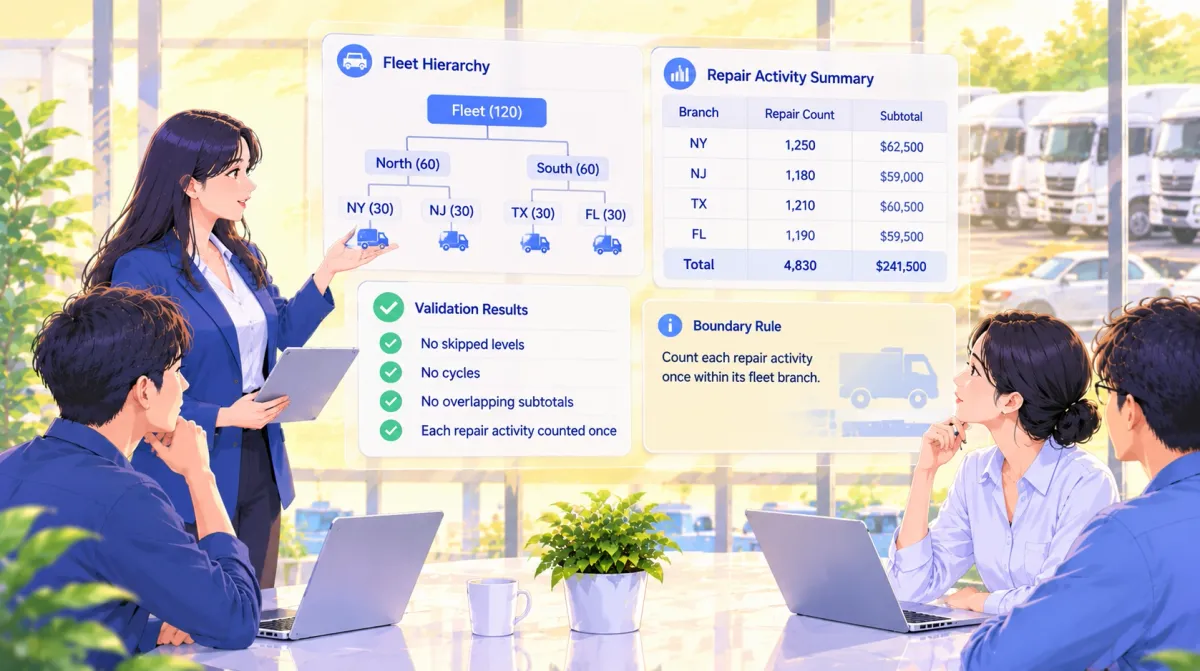
Series: The Modeling Room, module 4, article 23 of 26. Build the parent-child map behind one fleet report, set a boundary where each repair activity counts once, and test the branches for skipped levels, cycles, and overlapping subtotals.
Who should read it?
Students learning modelstorming, analysts, report builders, data modelers working with business experts
Prerequisite
Simple hierarchy rules from part 9 and the difference between recorded context and unsupported claims, as in article 22
Learning objective
Choose and test a hierarchy rollup boundary without counting the same bike activity at several levels
Artifact
1 fleet map table carrying members with immediate parents, reachable bike pairs with link distances, and the counting boundary with expected matches
Why this matters
A fleet report can drop Emma's bike or count Northline's work twice and still look tidy. Both failures come from one missing decision:
- Which nodes each activity counts under.
This lesson gives you the map and the boundary rule that keep such a report honest.
What you'll learn
- How to build a parent-child map for a fleet whose branches run to different depths, with rules that reject cycles and second parents.
- How to set a reporting boundary where each activity counts once and overlapping subtotals stay unadded.
Your output: one fleet map table with members, pairs, and expected matches.
New terms: ragged hierarchy; variable depth and the recursive relationship that stores it; multilevel fact.