
The Modeling Room: (M4) Handle realistic exceptions - (A22) Model reasons and methods
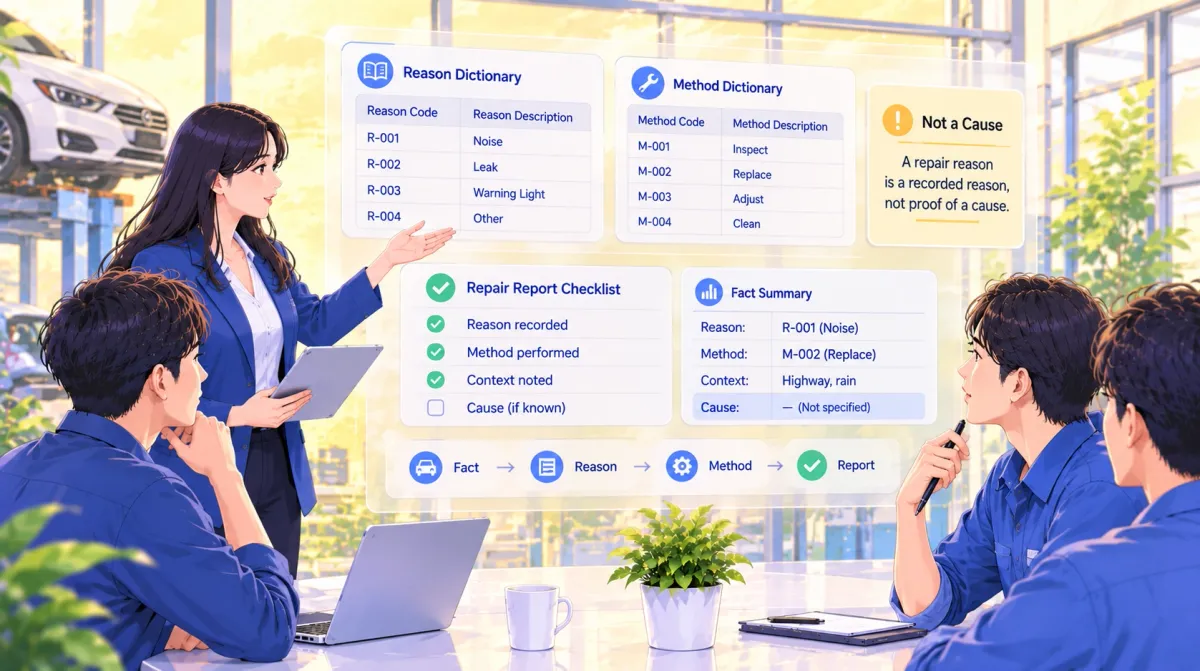
Series: The Modeling Room, module 4, article 22 of 26. Separate recorded reasons, performed methods, and observed context on the fact. Build a reason and method dictionary and one compact checklist dimension whose unknowns stay visible, so a reason report filters context without claiming a cause.
Who should read it?
Students learning modelstorming, analysts, report builders, data modelers working with business experts
Prerequisite
Telling overlapping participation apart from allocation, as in article 21
Learning objective
Classify event context so a reason report does not overclaim causal evidence
Artifact
A reason and method dictionary plus one compact checklist dimension with an explicit unknown state
Why this matters
A dashboard shows more labor hours on recall-related repairs. Alex Morgan reads it as "the recall caused the extra work." The records support a narrower statement: those jobs carried a recall label. A report that turns a recorded reason into a cause drives decisions the data never justified. This lesson sets that boundary first.
What you'll learn
- How to define a recorded reason, a performed method, and observed context with their supplier and permitted claim.
- How to build one compact checklist dimension whose unknown answers stay visible.
Your output: a reason and method dictionary plus one checklist dimension with its claim boundary.
New terms: causal dimension, junk dimension, and pivoted dimension PD