
The Modeling Room: (M4) Handle realistic exceptions - (A24) Model changing profiles
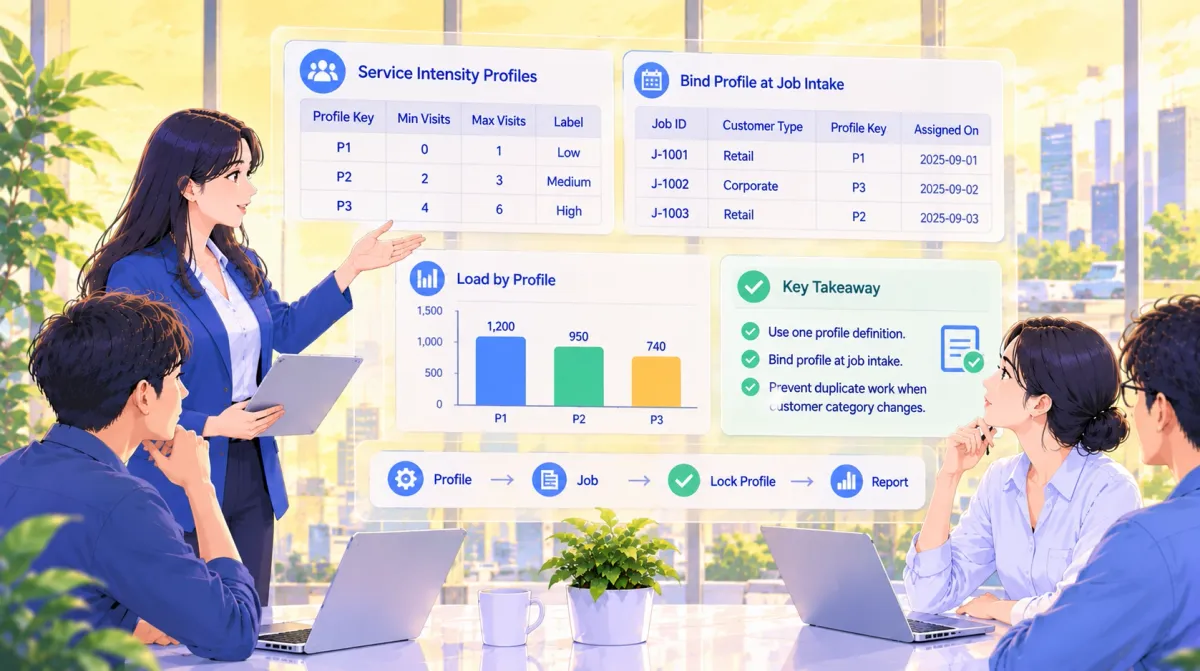
Series: The Modeling Room, module 4, article 24 of 26. Define one service-intensity profile with exact bands and stable keys, then bind each job to the profile valid at its intake so a changing category never duplicates work or silently rewrites history.
Who should read it?
Students learning modelstorming, analysts, report builders, data modelers working with business experts
Prerequisite
Preserve a reporting boundary and its time meaning, as in article 23
Learning objective
Preserve event-time profile classifications in a justified mini-dimension with unambiguous bands
Artifact
A profile definition, a band table with boundary tests, and an event-to-profile mapping
Why this matters
Alex Morgan wants to know which September jobs came from customers who were already heavy service users. Emma Brooks had another visit on September 20. Her name and customer ID do not change; her service profile does. If every profile change creates a complete new CUSTOMER version, the table grows fast and old jobs pick up labels that were not theirs.
What you'll learn
- How to define a profile with exact bands and stable keys, and decide whether it earns its own dimension.
- How to bind each event to the profile that was valid when the event happened.
Your output: a profile definition, a band table with boundary tests, and an event-to-profile mapping.
New terms: band and mini-dimension