Whole Brain Emulation: The "Cheating" Path to AI
Part 5 of Series "Exploring Superintelligence". Whole brain emulation seeks to create intelligence by scanning and simulating biological brains. This approach relies on advanced scanning, translation, and simulation technologies rather than theoretical breakthroughs.
This is the 5th article of the series exploring the cheating path of AI. Previously, we looked at system architectures and failure modes. Now, we examine a method that bypasses the need to understand intelligence by simply copying it from nature.
Whole Brain Emulation: The "Cheating" Path to AI
In the world of synthetic AI, we try to code intelligence from scratch. We look for elegant algorithms, such as decision trees, neural networks, Bayesian inference that capture the essence of reasoning. But Nick Bostrom’s Superintelligence describes a different path, one that he calls "barefaced plagiarism" of nature: Whole Brain Emulation (WBE).
Instead of figuring out how the mind works, we simply copy the hardware that runs it.
The Core Concept: Emulation vs. Understanding
The premise of WBE is that we don't need a theoretical breakthrough in understanding consciousness or general intelligence to build a superintelligence. We just need to understand the low-level functional characteristics of the brain's computational elements.
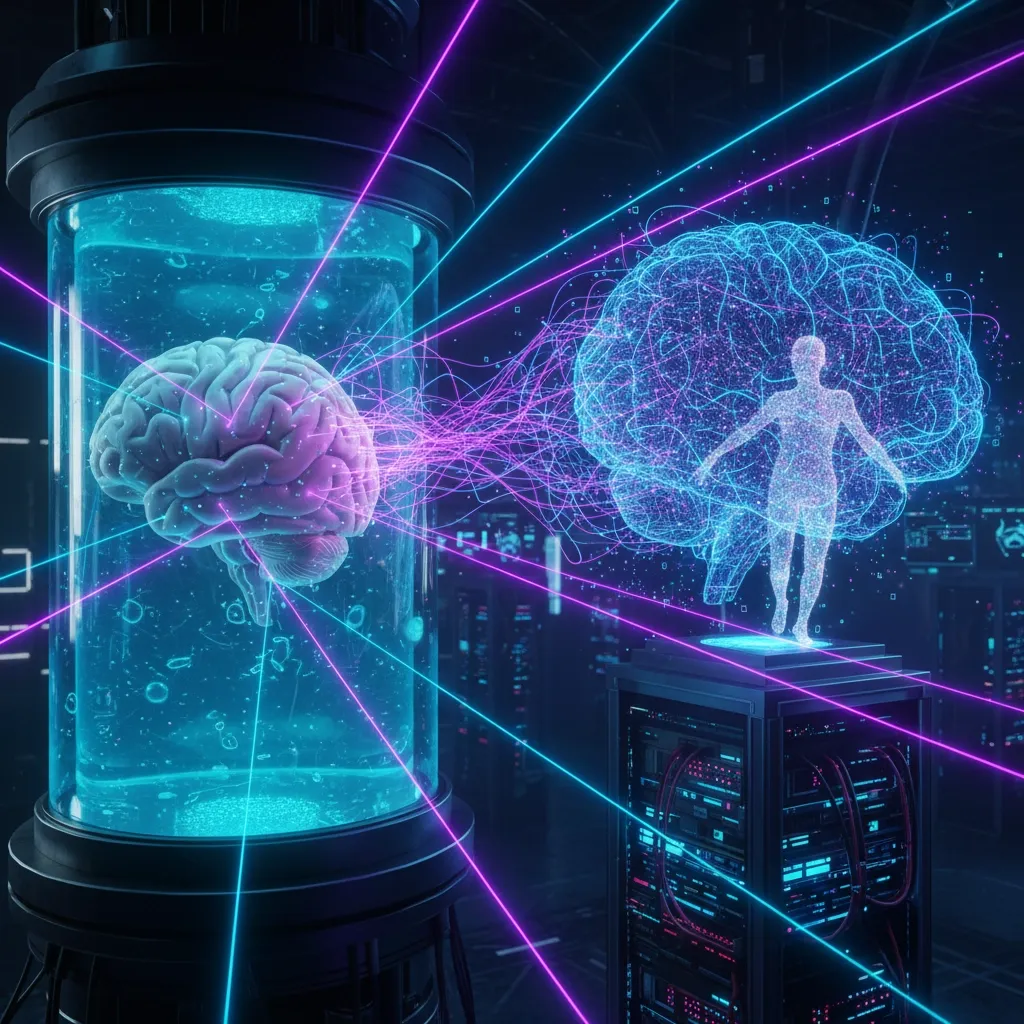
The process involves taking a biological brain (likely post-mortem), freezing it, slicing it into microscopic layers, and scanning it. We then reconstruct the 3D neuronal network in a digital substrate. If successful, the result is a digital intellect with the memory and personality of the original human intact. It is the ultimate "black box" model. We run the code, but we might not know how it generates the output.
The Big Data/Tech Perspective: The Three Pillars
For data scientists and engineers, WBE is less about AI theory and more about extreme data processing and hardware scaling. Bostrom details the technological roadmap as three distinct challenges:
- Scanning (Microscopy): We need high-throughput microscopy capable of scanning brain tissue at sufficient resolution to detect individual synapses. This generates an avalanche of raw data that dwarfs the current global internet traffic.
- Translation (Image Processing): This is essentially a massive computer vision problem. We need automated image analysis to turn stacks of 2D electron microscope images into a consistent 3D model of neuronal connectivity (the connectome).
- Simulation (Hardware): We need hardware powerful enough to run this massive model in real-time (or faster).
Bostrom notes that while no fundamental conceptual breakthrough is needed, the engineering challenges are immense. We are currently moving from emulating simple worms like C. elegans to larger organisms, but a human brain is orders of magnitude more complex.
The Philosophy/Ethics Perspective: Identity and Digital Slavery
If the technical challenges are daunting, the ethical ones are terrifying. WBE forces us to confront questions that usually belong in seminar rooms, not server rooms.
- The Identity Problem:
- If you scan your brain and run it on a computer, is it you? Or is it just a copy that thinks it is you?
- If the original biological brain is destroyed in the scanning process, have you achieved immortality or committed suicide?
- Digital Slavery: In a post-transition economy, digital minds (emulations) could be copied effortlessly. This leads to the "Voluntary Slavery" scenarios discussed in Chapter 11. An employer could spawn a new copy of a highly skilled worker to handle a specific task and then delete it when the task is done to save on server costs.
- Mind Crime: If these emulations are conscious, deleting them or forcing them to work in simulated sweatshops constitutes suffering on a massive scale. We might inadvertently create a "Disneyland without children"; a technologically advanced society largely void of moral value or joy.
Netflix Connection: The "Uploaded Intelligence" of Pantheon
If Bostrom’s technical roadmap feels too abstract, the animated series Pantheon offers a visceral visualization of these concepts. In the show, characters undergo a process remarkably similar to Bostrom’s "scanning" phase—a destructive scan that digitizes the biological brain to create a "UI" (Uploaded Intelligence).
Pantheon dramatizes the exact ethical nightmares Bostrom warns about:
- The Identity Problem: The show grapples with whether the UI is the original person or just a copy.
- Digital Slavery: We see UIs forced to work in simulated sweatshops, optimizing code or solving problems for corporations—a direct realization of the "Voluntary Slavery" scenario.
- Resource Constraints: The characters fight for "processing power" and server space, illustrating how a digital existence is physically constrained by hardware availability (Bostrom’s "Hardware Overhang" concept).
While Pantheon is fiction, its depiction of the "messy" transition from biology to data aligns chillingly well with the "cheating path" Bostrom describes. It reminds us that "uploading" isn't just about code; it's about the continuity of the human experience.
Takeaway
Whole Brain Emulation represents a "brute force" path to superintelligence. It trades theoretical difficulty for technological complexity. As data professionals, we must realize that processing this data isn't just about optimizing storage or latency; it involves handling the digital substrate of human souls.
Next
In the next post, we will look at The Kinetics of the Takeoff. Will the transition to superintelligence be a slow, manageable climb, or a vertical line that catches us completely off guard?
Series Parts
- The Orthogonality Thesis: Why Smart Models Can Have "Dumb" Goals
- Instrumental Convergence: The Universal Sub-Goals of AI
- The Treacherous Turn: When Validation Sets Fail
- Oracles, Genies, and Sovereigns: Choosing the System Architecture
- Whole Brain Emulation: The "Cheating" Path to AI
- The Kinetics of the Takeoff: Hard vs. Soft Takeoff; next