
The search engine that never phones home: what local semantic search keeps private
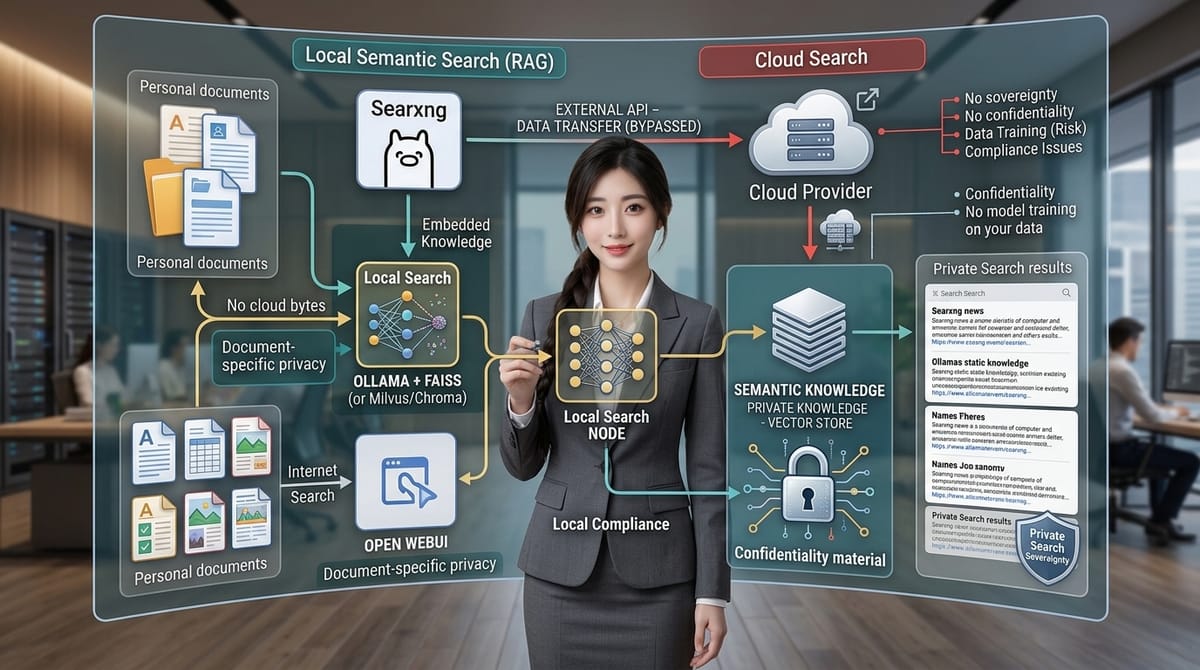
Local semantic search (local RAG) answers questions over your own documents without a byte reaching a cloud provider. We explain how it works in plain terms, then walk through what it protects: data sovereignty, confidential material, no training on your data, and compliance.
Who should read it?
Anyone who handles documents they would not hand to a 3rd-party: developers, analysts, small teams with confidential material.
Intro
You have probably stopped noticing the ritual. You open a chat window, you upload a file, you ask a question, and somewhere the answer comes back. What you rarely ask is: "Where did the file go?", "Who else reads it?", and "What happens to it after the answer arrives?". With most AI search tools the honest answer is "somewhere on someone else's infrastructure, under terms you agreed to without reading".
Local retrieval-augmented generation (RAG)
There is an alternative, and it is less exotic than it sounds. It is usually called local RAG, and it means running the whole pipeline, from turning your documents into searchable form to generating the answer, on your own machine. Nothing is uploaded, nothing is processed remotely, and nothing lingers in a vendor's systems. This article is about why that architecture matters, not how to set it up. But to see what it protects, you first need a rough picture of what is actually happening under the hood.
What local RAG actually is, in plain terms
Search engines, in the classic sense, match keywords. Ask them for "quarterly risk exposure" and they find documents containing those words, then fail on a document that says "Q3 liabilities" because the words do not match. Semantic search fixes this by caring about meaning rather than wording.
The trick is a 2-step translation
First, an embedding model reads each chunk of your text and converts it into a list of numbers, a vector, where documents that mean similar things get similar numbers. "Quarterly risk exposure" and "Q3 liabilities" land close together in this number space even though they share no words. This conversion is done by a model, and in a local setup that model runs directly on your own hardware; something like Google's google/embeddinggemma-300m, a small open embedding model built for on-device use, runs comfortably on a laptop. The model itself is small and fixed. It is a translator, not a student.
Second, all those vectors get stored in an index, a structure that makes it fast to find "the vectors closest to my question." The common open-source tool for this is FAISS. The index is just a file on your disk, like a spreadsheet or a PDF. You own it, you can copy it, and you can delete it.
Then comes the answering. You type a question, the system converts it to a vector, finds the most relevant chunks of your documents in the index, and hands them, together with your question, to a language model that writes the answer. In local setups that model typically runs through something like Ollama, again entirely on your machine. The model reads the retrieved text as temporary context, like an open book on the desk, and answers from it.
That is the whole system: a translator, a file full of vectors, and a language model, all resident on your hardware. The privacy story follows directly from that geography. Everything an outsider could learn lives in places an outsider cannot reach.
Data sovereignty: the data never leaves
The core claim of local semantic search is almost embarrassingly simple: your data never leaves your machine. With cloud-based tools, the workflow starts with an upload. Your files travel to a remote server, get processed there, and the terms of that processing are whatever the vendor's policy says this week. The local workflow starts nowhere, because there is no upload step to start.
Look at where the sensitive moments are and where they happen:
- The embedding step, where your text becomes vectors, runs on a local model on your hardware. No text is transmitted to produce it.
- The index lives on your disk. There is no external database holding your documents, so there is no external database to breach, subpoena, or quietly repurpose.
- The query step, where your question and the retrieved context meet the language model, is processed by a local model. Your prompts, which for many people are the most revealing artifact of all, never touch a cloud API.
This is what "complete data sovereignty" means in practice, and it is stronger than it first sounds. Most discussions of cloud privacy are really discussions about trust: "Can you trust the vendor, their subcontractors, their security team, their lawyers?". A local architecture does not answer those questions. It deletes them. There is no third party involved at any point in the pipeline, so there is no one to trust and no one to audit. The only machine that ever sees your document is the one already sitting on your desk.
What this makes safe to work with
The sovereignty argument is abstract until you look at the documents people actually want to search. Local systems are uniquely suited to material that cannot, legally or ethically, be uploaded to a stranger's server.
For personal use
Personal finance data is the obvious domestic case. A local search over years of statements, tax documents, and contracts answers "What did I agree to in the 2023 lease?" without those documents ever leaving the house. Legal contracts and medical records fall in the same category: confidential by nature, often confidential by obligation, and exactly the files people are tempted to feed to a convenient AI tool because the alternative is reading all of them.
For developers and data scientists
The stakes are intellectual property. Proprietary code is a company's competitive core, and public AI assistants that autocomplete or explain code receive that code as input. Local tooling lets you write, refactor, and document proprietary software while the assistant works entirely inside your perimeter. The convenience does not require leaking the source.
For organizations
The pattern scales up into what is often called an internal RAG assistant: a search-and-answer system wired to corporate knowledge sources, for instance an ElasticSearch index behind the firewall, that employees query in natural language. The assistant answers from that knowledge base, and the employees' documents and prompts stay inside the corporate network. The same caution applies here as everywhere else in this piece: the deployment is only as local as its weakest link, and an internal assistant that quietly calls out to a hosted API for any part of its pipeline gives the promise back. Every advantage that makes a local setup attractive on one laptop applies at this scale, with one addition: the perimeter is now the company's own firewall rather than a single machine.
Frozen models: your data is context, not curriculum
The 2nd concern with public AI services is subtler than exposure. It is retention. When you upload documents to a hosted service, a reasonable question is: "What happens to them after this conversation?", "Are they deleted, kept for abuse review, or folded into the training data for next year's model?". For many services the answer is "we might," which is not an answer. s
Local RAG has a structurally clean answer, and it comes from how the models work. The models involved are frozen: fixed at their training state, never updated by what they read. When the local language model answers a question using your retrieved documents, those documents are temporary context for that one answer and nothing more. The model does not learn from them, does not weight toward them, and does not remember them. Ask the same question in a fresh session and it has to retrieve the documents again, because it never retained them the first time.
This is the difference between reading and training, and it is worth spelling out. A cloud provider that trains on user data turns your documents into permanent, irreversible parts of a model that is then shared with millions of people. A frozen local model turns your documents into a lookup it performs on demand: the retrieved text sits in the context window for that one answer and is discarded when the session ends. Your text influences the answer; it never influences the model.
The corollary is lifecycle control. You own the index, so you own the deletion story. Remove a document from a local index and it is gone from the index, immediately, in the only place the pipeline stored it. That claim has one precondition worth stating: it holds because nothing was fine-tuned on your data. If a model in your stack had been retrained on the documents, deletion would be a retraining problem, not a file operation, and the companion article on GDPR compliance covers exactly that failure mode. For a frozen model over a plain index, though, the contrast with cloud services needs no embellishment: deletion that is a file operation instead of a support ticket.
Compliance and the smaller attack surface
For organizations, the argument becomes regulatory. Frameworks like the EU AI Act and GDPR put strict conditions on where personal data goes, who processes it, and how decisions can be traced. A local search architecture is not a compliance certificate by itself, but it is an architecture that makes compliance dramatically easier to argue. Reasons:
- Risk mitigation through consolidation.
- Auditability.
Risk mitigation
In a typical cloud AI setup, your data's security depends on your own systems plus every vendor in the chain: the API provider, their hosting provider, their downstream dependencies. Each link is an attack surface, a breach risk, and a due-diligence obligation. A local setup keeps the entire AI stack, the inference engine, the vector database, and the frontend, behind your own firewall or inside your own container. The number of parties who can lose your data drops to one, and that one is you.
Auditability
Compliance regimes increasingly demand transparency and accountability: show how the system works, log what it did, explain what it accessed. With a local system you have direct access to the logs and the decision process, because they are on your infrastructure. There is no vendor to file a request with, no data-processing agreement to interpret, and the system's behavior is describable without reverse engineering a service you cannot see inside. That inspectability is close to what those frameworks actually ask for.
The honest limits
It would be dishonest to end on the compliance note, because local RAG is not automatically secure, and treating it as if it were is its own failure mode. The architecture removes 3rd-parties from the pipeline. It does not remove risk; it relocates all of it onto you.
The machine itself is now the entire threat model. If your laptop is compromised, everything the cloud vendor would have had access to is available in one place, with no vendor security team between an attacker and the full document set. Physical access counts too: an unencrypted disk with an unguarded index is a worse privacy posture than a reputable cloud service, not a better one.
And weak local setups are real. A model downloaded from an untrusted source, an index left world-readable on a shared machine, a "local" frontend that quietly proxies to a hosted API somewhere: none of these are hypothetical, and all of them break the sovereignty promise while keeping its marketing. Local means local all the way down, or it means nothing.
So the fair claim is not "local RAG is secure." It is: local RAG makes the security question tractable. One machine, one network, one disk, one set of practices you control and can verify, instead of an unbounded chain of vendors you cannot. Whether that trade is better depends on what you hold and how well you hold it. For confidential documents, proprietary code, and regulated data, the trade usually favors the local side, provided you treat your own machine with the seriousness you were outsourcing to someone else.
Key Takeaway
You do not need to build anything to use the idea. Use it as a test you apply to every AI tool before it touches your files: "Where does the embedding happen?", "Where does the index live?", "Who sees the prompt?", and "What happens to my data when I delete it?". Tools that cannot answer those four questions locally are asking you to trust a chain you cannot see. Local semantic search is the one architecture where you can see the whole chain, because you built every link of it.