
From PoC to a Data-Driven Company (And Why Step 3 Breaks Most of Them)
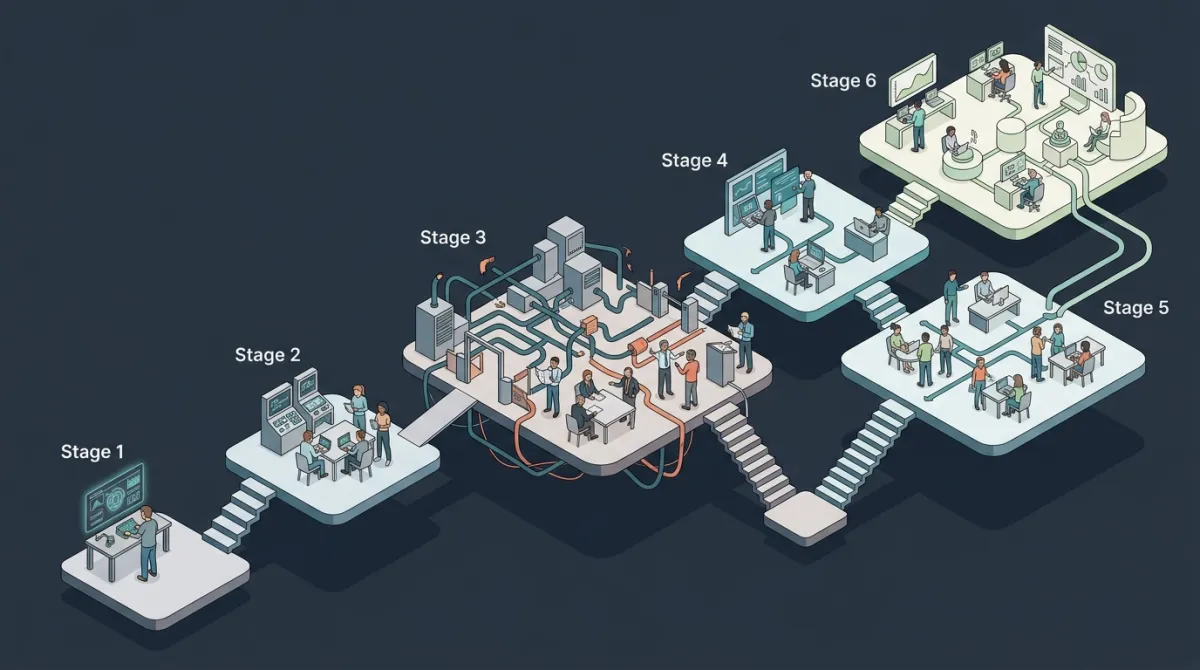
Becoming data-driven is not a project, it is a 6-step climb where most companies stall on the technical implementation. Walk the ladder, explain the change management that keeps people on board, and map the success factors across individuals, teams, and the whole company.
Who should read it?
executives, transformation leads, and everyone tired of hearing "our data science initiative lost momentum"
Intro
The pattern repeats across industries. A company announces its data strategy, hires a team, runs an impressive proof of concept, and 18 months later the initiative has quietly dissolved into a few dashboards nobody opens. The strategy was never the problem. The climb was.
"How does data science becomes part of a company rather than a project inside it?". Its answer has 3 parts, and they map cleanly onto what organizations actually experience:
- A 6-step implementation ladder
- A change management discipline for the people on the ladder
- A success-factor matrix for keeping the whole thing alive.
The six-step ladder
Step 1: Find use cases. A creative opener that works is an "ideas competition" (gameification), where employees submit proposals. The winning idea gets the time to pursue it. Use a counterintuitive sequencing trick: let's say there are 5 collected use cases, then start with the 3-best idea, not the best. If the best idea fails on a technical obstacle, it burns credibility; the 3-best will likely clear the bar, prove the concept, and buy political capital for the stronger ideas. Keep the best idea warm; do not waste it on a debut.
Step 2: Proof of concept. Start small. No multi-year cloud contracts, no infrastructure shopping spree. Instead use open-source tools, static data dumps, even Excel files if that is what you need. Define time and scope like any project. Be aware: going through the technical option space can be an expensive path.
Step 3: Technical implementation. After successful PoCs, build the first complete technical pipeline: data integration, storage, preparation, productive serving, all connected end to end with real data. Do not do everything and do not do polishing. The goal is proving the overall concept works at company scale. Expect setbacks and unplanned costs; Complexity and unknowns live here (the Rumsfeld matrix). This is where most initiatives stall, and step 4 is the reason, see below.
Step 4: Department-level rollout. Train the first departments on the new platform. New use cases arrive, and with them new data sources and new demands on the platform, which means more complexity and more unplanned cost. Here is the trap: at this point data science and infrastructure have almost certainly not produced a return on investment (ROI) yet. The path from step 1 to here takes months at minimum and is nearly all cost.
Action Item: Be transparent and tell funders this in advance to avoid disappointment.
Step 5: Company-wide scaling. With several department-level wins to tell as stories, scale across the company. By this maturity level, metadata is organized, data quality is taken seriously everywhere, there is an actual strategy (at the latest), and a community or center of excellence spreads knowledge. Not everyone will believe data science works here: Take the skeptics along with rational arguments and good stories, because both facts and emotions move people.
Step 6: Institutionalization. There is no final step, only a continuous process. A data-driven culture is not a milestone; it is a permanent effort of rethinking, learning, and technical skill-building. The three evaluation lenses throughout:
- Feasibility (tested in steps 2-3)
- Profitability (measured continuously)
- Desirability ("Do the market and the employees actually want this?").
Change management: the part that decides whether any of this survives
People are creatures of habit. Every new tool, topic, or process demands cognitive effort to learn, even for curious people in flexible work environments. That single fact generates most change resistance, and change management is an ongoing discipline rather than a phase.
2 mechanisms matter most:
- Anticipate the fears
- When communication goes digital or a new platform lands, employees do not just see software; some people quietly fear losing their job or their standing because their skills no longer fit. Decision-makers who ignore this get resistance they cannot explain. The practical sequence: identify what will change, ask where the fears come from (skills, situation, organizational or cultural barriers), then address them openly.
- Communicate the "why" before the "what"
- Borrowing Sinek's golden circle: explain why the change is needed (changed market conditions, aging systems, better customer experience) before describing how and what. It will not convince everyone; it convinces most.
3 tools carry the weight:
- Change agents and friendly-users.
- People who have been through the change and can vouch for it become ambassadors for the uncertain. Friendly-users get early access, which surfaces bugs before a skeptical employee finds one, because if an unsure person tries the software, it fails, and you hear "I told you so," the damage radiates far beyond that one person.
- The Lippitt-Knoster model.
- Managing complex change needs vision, incentives, resources, and an action plan. Miss any one of them, and the result is predictable:
- No vision produces confusion
- No incentives produce resistance
- No resources produce frustration
- No plan produces a false start.
- Evaluate the change continuously, in the agile sense. Inspect & adapt.
- Managing complex change needs vision, incentives, resources, and an action plan. Miss any one of them, and the result is predictable:
- ADKAR = Awareness, Desire, Knowledge, Ability, Reinforcement
- communicate and explain the causes, address fears and highlight advantages, train people, enable them, then anchor the change with adapted processes and visible wins.
Clear structures give people security, but strong hierarchies do the opposite, they put people under pressure and generate exactly the fear that kills adoption.
Data management: the quiet foundation
None of the ladder works without the boring layer underneath. Data management, in synthesis of the Gartner definition, is the discipline that structures, describes, and governs information across organizational and technical boundaries.
Its process runs from collecting, developing, storing, cataloging, and integrating data to generating value, sharing it, documenting, and managing it, with reuse loops instead of copy loops.
Data governance is the part that decides who has authority over data and how it may be used, and it stays central even when responsibility for data sources is distributed to departments.
The trust gap is the part executives should see. In a Capgemini survey (500 tech leaders, 504 executives), ~60% of technical leaders said decisions were being made on their curated data, but only 20% of executives said they trusted the data they received. Translation: the people building the data believe in it, the people paying for it mostly do not. The fix is transparency: show leadership where data comes from, how it is processed, and what it can and cannot say. Transparency also builds ownership among employees, who start finding and fixing quality problems themselves.
The forward trends: real-time integration, data democratization, data as a marketable product, data fabric and data mesh, data observability (measurability of data assets, quality alerts, lineage), and cross-functional data teams are treated like HR or finance rather than a support function.
Alongside data management sits IT management: hardware, operating systems, application systems, data storage systems, networks, and cloud resources, which are physical devices somewhere else, not a magic layer exempt from management. The service discipline is ITSM with ITIL as the de facto standard playbook, and since algorithms and AI are software and deliverable as services, this is part of data science management, including safety and security oversight.
The success-factor matrix: keeping it alive
4 dimensions (profitability, governance, culture, infrastructure) at 3 levels (individuals, teams and projects, company and strategy).
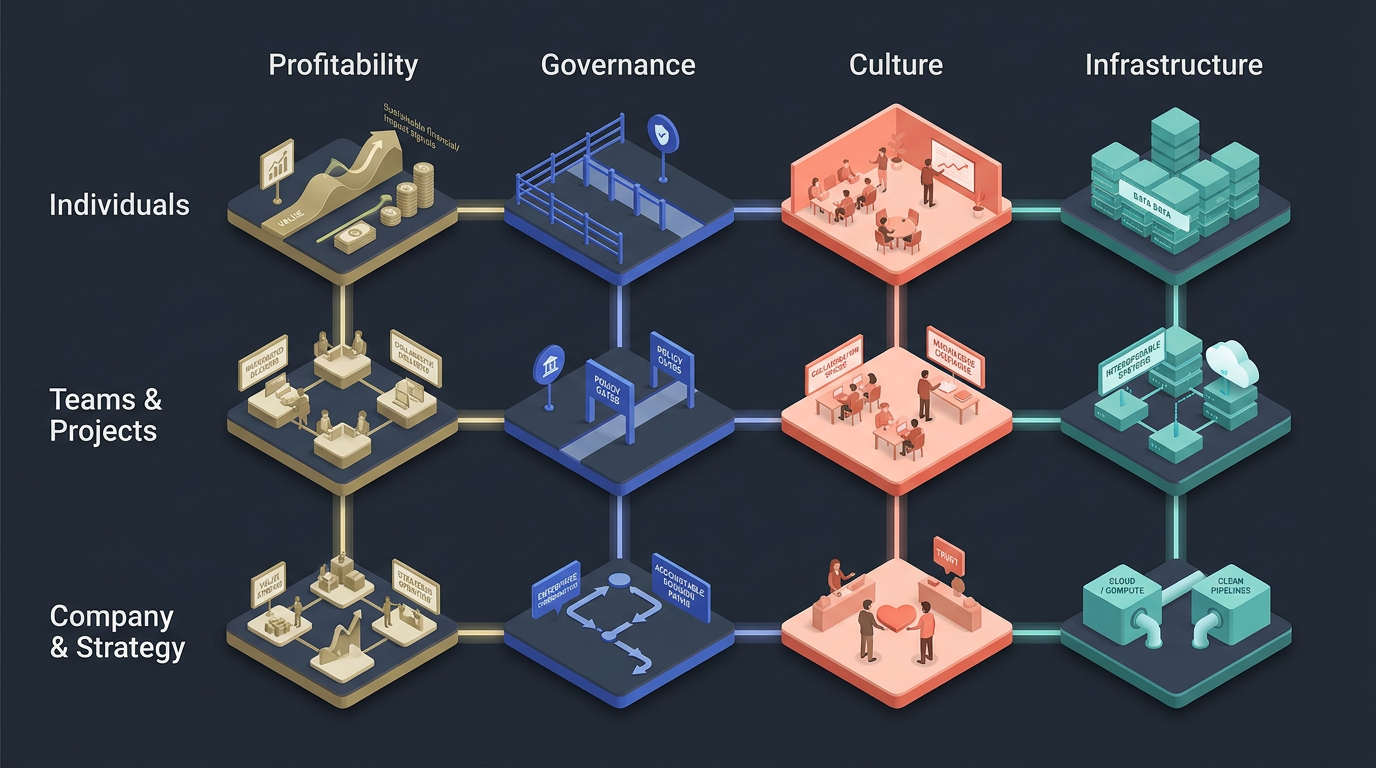
At the individual level: data scientists should think economically even though it is not their core job; governance includes realistic job postings (no "expert in three programming languages") and mentoring; culture means pair programming, exchange with domain users, plain language over jargon (metaphors include people, jargon excludes them), and failure culture to allow learning and improvement. Failure teaches only when conclusions are drawn and shared.
At the team and project level: transparency about goals and resources; do not underestimate the cost of data preparation, budget generously; use standard frameworks instead of reinventing wheels; keep requirements creative, not airtight, so the team's swarm intelligence can work; data quality improvement is a community project, not a department's chore.
At the company level: C-level commitment is the difference between a stalled initiative and a sustained one, because when implementation hits its inevitable rough patch, executive sponsorship is what keeps funding and patience alive. Data silos sometimes need to be broken top-down, with authority. Short-term savings estimates are usually wrong; think in years. And: companies should use their own data science products, not just sell them, because using them builds understanding, improves the products, and buys credibility.
Culture cannot be decreed. It crystallizes at team and organization level, and every individual is part of it. Processes can be set in motion; the culture follows the behavior that gets rewarded.
Key Takeaways
If you are planning or rescuing a data science initiative:
- Locate yourself on the ladder honestly. Most initiatives overestimate their step; step 4 (cost-heavy, no ROI yet) is the single most useful sentence to bring to a budget meeting.
- Run change management as a discipline, not a memo: name the fears, communicate why first, deploy change agents, and evaluate continuously.
- Use the matrix as an annual review: for each of the four dimensions, ask "What changed at the individual, team, and company level in the last year?". Blanks indicate the next bottleneck before it breaks something.