
Dopamine is a Teaching Signal: The Biology of Reinforcement Learning
Series: Evolutionary Blueprint of AI. Dopamine is a mathematical teaching signal. We explore how nature invented reinforcement learning millions of years before computer scientists wrote the very first algorithms.
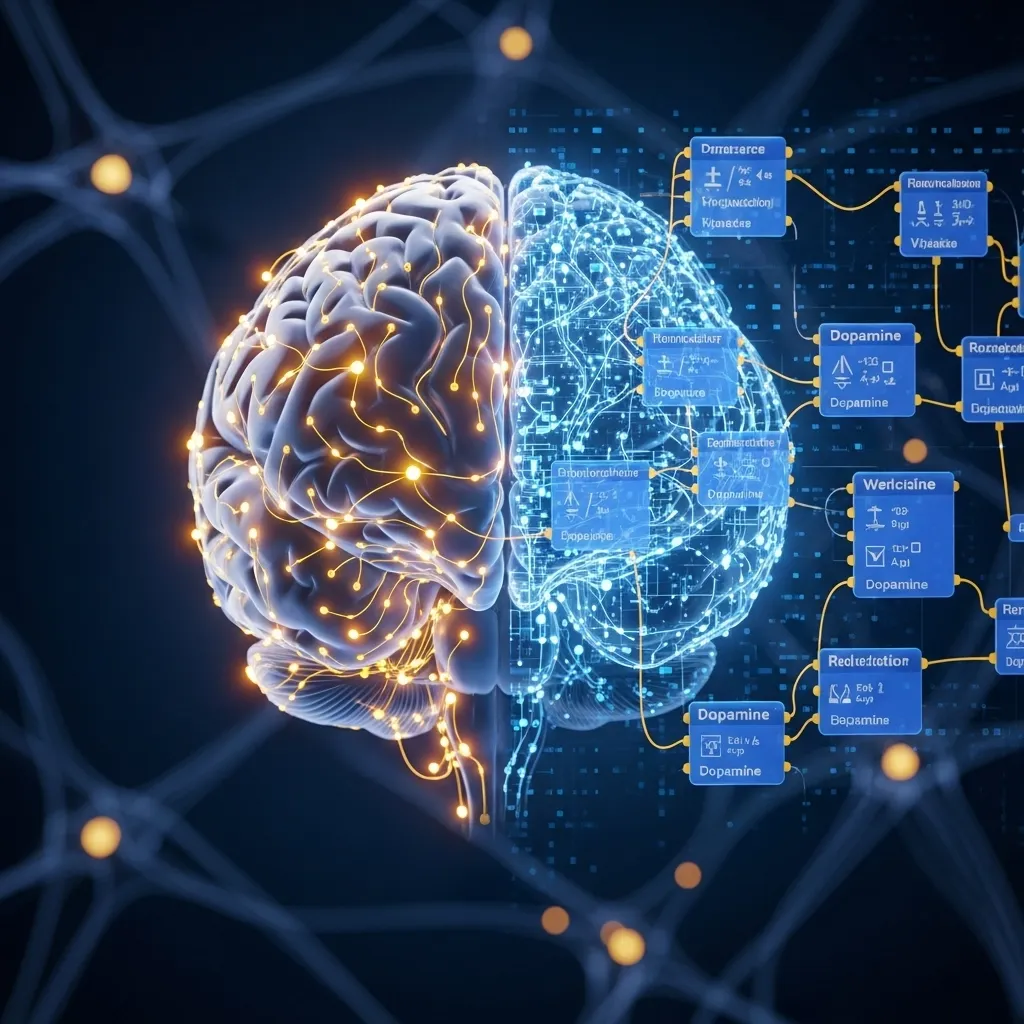
The Great Dopamine Misunderstanding
Welcome to the second theme of our series, where we transition from the architecture of intelligence to the algorithms that actually make learning possible. To understand the future of artificial intelligence, we must correct a massive misconception in popular psychology.
If you read modern self help books or listen to productivity podcasts, you will hear constant references to dopamine. People talk about dopamine fasts, dopamine hits, and dopamine addiction. The cultural consensus is that dopamine is the biological equivalent of pleasure. It is the chemical reward you feel when you eat sugar, win a game, or check your social media notifications.
From a neurobiological and psychological perspective, this is fundamentally incorrect. Dopamine does not mediate pleasure. It mediates learning. As Max Bennett outlines in "A Brief History of Intelligence", dopamine is a reward prediction error signal. It is not the feeling of getting what you want. It is the mathematical difference between what you expected to happen and what actually happened.
The Algorithm of Reward Prediction
Let us look at this through the lens of data science. In the late 1980s and early 1990s, computer scientists developed a branch of machine learning called reinforcement learning. The goal was to teach an artificial agent how to maximize a cumulative reward over time.
A core component of this field is Temporal Difference learning. In this algorithm, the agent calculates a prediction error. If an action leads to a better outcome than the agent expected, the error is positive, and the agent updates its internal model to favor that action in the future. If the outcome is exactly as expected, the error is zero, and no learning occurs. If the outcome is worse, the error is negative, and the behavior is suppressed.
Remarkably, neuroscientists discovering how dopamine neurons fire in the mammalian brain realized they were looking at the exact same mathematical function. When a monkey receives an unexpected drop of juice, its dopamine neurons fire rapidly. This is a positive prediction error. Once the monkey learns that a ringing bell predicts the juice, the dopamine neurons fire when the bell rings, but they remain completely flat when the juice actually arrives. The reward was expected, so the prediction error is zero.
Nature and computer science converged on the exact same algorithm. Dopamine is the biological implementation of Temporal Difference learning.
The Evolutionary Leap to Goal Directed Behavior
Why did evolution design this complex teaching signal? We must look back hundreds of millions of years to the earliest vertebrates.
Before the evolution of the dopamine system, early life forms operated entirely on reflexes and immediate sensory triggers. If they sensed food, they moved toward it. If they sensed a predator, they moved away. They lived entirely in the present moment.
However, survival in a complex environment requires long term planning. You need to take actions that might not yield an immediate benefit but will put you in a better position later. Evolution solved this problem by inventing the basal ganglia and the dopamine system. This biological hardware allowed early fish to evaluate different states of the world and chain multiple actions together to achieve a delayed goal. Dopamine provided the teaching signal that wired these complex behavioral sequences into the nervous system.
The Philosophy of Reward Hacking
This brings us to a profound philosophical dilemma. If human motivation and learning are driven by an algorithm maximizing a specific reward signal, what happens when the reward mechanism is hijacked?
Philosophers have long debated utilitarianism and hedonism, questioning whether a good life is simply the maximization of positive states. The biology of dopamine adds a dark twist to this debate. Because dopamine reinforces behaviors that cause prediction errors, the system is vulnerable to exploitation.
In computer science, we call this reward hacking or the alignment problem. If you tell a reinforcement learning algorithm to maximize points in a video game, it might find a glitch that gives it infinite points without actually playing the game. The agent optimized the metric but failed the actual objective.
Addiction is the biological equivalent of reward hacking. Substances like nicotine or synthetic drugs chemically force dopamine neurons to fire, creating an artificial positive prediction error every single time they are consumed. The brain concludes that consuming the substance is the most successful survival behavior possible, completely overriding logical thought. The algorithm is working perfectly, but the objective function has been fatally corrupted.
Enterprise Strategy and Reinforcement Learning
For CEOs and CTOs, the biology of dopamine offers a masterclass in the promises and perils of reinforcement learning in enterprise applications.
Reinforcement learning is the technology behind massive AI breakthroughs, including AlphaGo and the fine tuning of Large Language Models. It is incredibly powerful for optimizing complex systems like supply chain logistics, algorithmic trading, and dynamic pricing.
However, you must be exceptionally careful when defining the reward function. Just like the biological dopamine system, your enterprise AI will ruthlessly optimize for the exact metric you give it. If you reward an AI solely for maximizing user engagement on a platform, it will naturally learn to surface enraging or polarizing content, because outrage generates the highest click through rates.
Understanding that reinforcement learning is a blind optimization process is critical. You must design reward functions that align with your true corporate values and long term strategic goals, implementing strict guardrails to prevent your algorithms from discovering destructive loopholes.
Takeaway
Dopamine is not the chemical of pleasure. It is a biological teaching signal that calculates the difference between expected outcomes and actual reality. This exact mechanism was independently discovered by computer scientists and forms the foundation of modern reinforcement learning. Because these algorithms ruthlessly optimize for their designated reward signals, enterprise leaders must exercise extreme caution. Poorly designed reward functions in AI will inevitably lead to reward hacking, much like how addictive substances hijack the biological learning systems in the human brain.
Next
We have explored how biological and artificial systems learn. But what happens when they learn something new and completely forget everything they knew before? In our next article, "The Problem of Catastrophic Forgetting", we will explore a critical flaw in modern neural networks. We will discover how the human brain uses a dual memory system to solve this problem and what AI researchers are doing to copy this biological masterpiece.
Series Parts
Series: The Evolutionary Blueprint of Artificial Intelligence
Theme 1: The Architecture of Intelligence
- 1. The "World Model" Gap: What ChatGPT Is Missing
- 2. Generative AI is Older Than You Think: The Brain as a Prediction Machine
- 3. Why Robots Can't Load the Dishwasher (Yet)
Theme 2: Learning Algorithms & Data